Swissphysiobhutan
  • Home
  • How to support
  • Partners
  • Weekly Blog
  • Contact & About
  • Home
  • How to support
  • Partners
  • Weekly Blog
  • Contact & About

Bhutan Physio

and culture blogs

Fieldwork in Wangdue

29/6/2026

0 Comments

 
Picture
From 19 to 24 June 2026, we went to Wangdue Phodrang for fieldwork. In total, I assessed 26 children and one elderly person.

The focus was mainly on children. However, word spread quickly that there was a foreign physiotherapist at the Primary Healthcare Centre (PHC). Soon, not only the children on our list came, but also people from further away. One man over 80, who had had a stroke, suddenly turned up at the PHC and asked to see the “foreign physiotherapist.” Even though he had to wait for several hours, he stayed. After assessing all the children who needed to be checked for assistive devices and given physiotherapy advice, I also had a look at him. Since his stroke, he had never been to hospital and had never received any exercises or treatment. His shoulder on the hemiparetic side was very stiff and painful, so I showed him some basic exercises.

At another PHC, a father came with his child, even though she was actually in hospital a few hours away with fever and had not eaten for five days. He came against the doctors’ recommendation because someone from his area had told him that there might be a foreign doctor who could perhaps operate on his daughter’s legs and make her walk properly. He held on to this small hope, even though the physiotherapists at the hospital had already explained that I was also a physiotherapist and would not be able to operate on his daughter.

In the end, I felt very sorry that I could not help the father and child in the way they had hoped. I could not even give them much useful advice. The daughter was not well enough for me to see her normal level of activity, so I could not properly assess her or give her father suitable exercises for home. I tried to give some suggestions based on what I knew about her situation, but the father was too caught up in his disappointment to really listen. So I sent them back to the hospital, as there was nothing more I could do in that situation. This moment showed me how desperate some parents are, but also how little they sometimes understand about their children’s diagnoses. Many do not realise that these conditions cannot simply be cured. In this case, I was not even sure what the child’s exact diagnosis was, as the father did not know. She definitely had seizures, but there was likely another underlying condition as well.

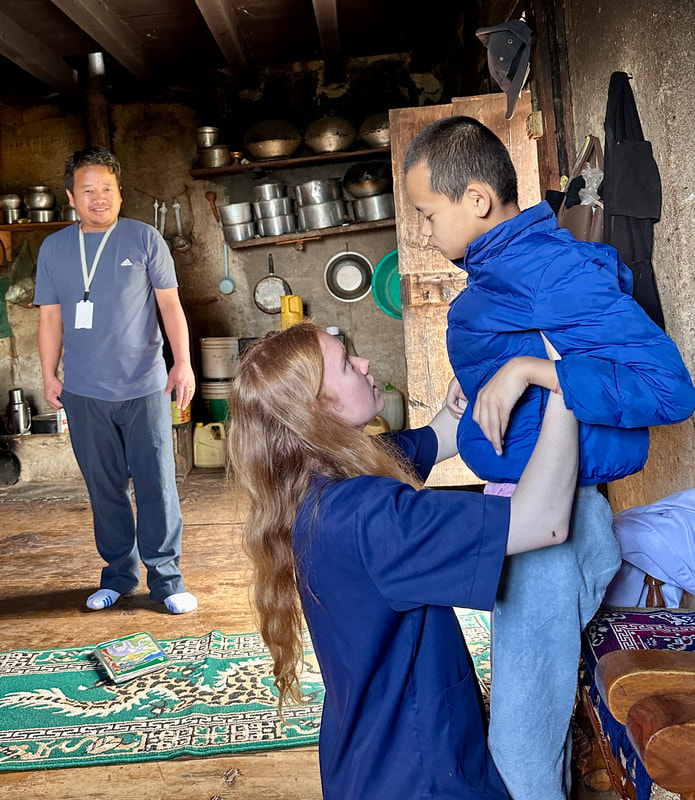
With another family, however, I felt I could really make a difference. We visited them at home for the intervention. The parents told us that they carry their 12-year-old son everywhere because he cannot stand or walk. They live in a traditional house with very high thresholds in front of every room, so a wheelchair is not very useful. From what I saw, I was not sure that the boy was truly unable to stand, so I gave it a try. I helped him up from the floor using a kinaesthetic approach, and he immediately activated his muscles and stood up without me carrying his weight. I only supported him for balance. He clearly enjoyed it — he was smiling and did not want to sit down again. I then showed the parents how to practise standing with him, because when the right movement pattern is activated, he can do it. I think the reason he had not stood with them before was that they did not know how to activate these movement patterns.
​
By the end, we even managed to take a few steps forward. I encouraged the parents to practise a lot every day and told them that he will most likely be able to walk from room to room if they continue practising and stop carrying him once he is able to do it himself. The parents were very grateful, as this could also reduce the burden on them in the future, especially as their son grows bigger and heavier.
here to edit.
0 Comments


Leave a Reply.

Copyright by schochworks gmbh. All rights reserved.