Swissphysiobhutan
  • Home
  • How to support
  • Partners
  • Weekly Blog
  • Contact & About
  • Home
  • How to support
  • Partners
  • Weekly Blog
  • Contact & About

Bhutan Physio

and culture blogs

Field work in Phobjikha

12/12/2025

0 Comments

 
Picture
On Friday morning, after arriving in Phobjikha the previous day, we visited one of the two local health-care units to speak with a health-care provider about children with disabilities in the area. He told us about four children—diagnosed with cerebral palsy, autism spectrum disorder, meningitis, and severe speech delay—and we decided to visit them.

What we encountered was both deeply moving and profoundly sad. Each of these children showed significant, often hidden potential, yet it is unlikely to be fully realized. Access to therapy is virtually nonexistent, and while the families do everything they can, they simply lack the knowledge and guidance needed to support their children effectively.

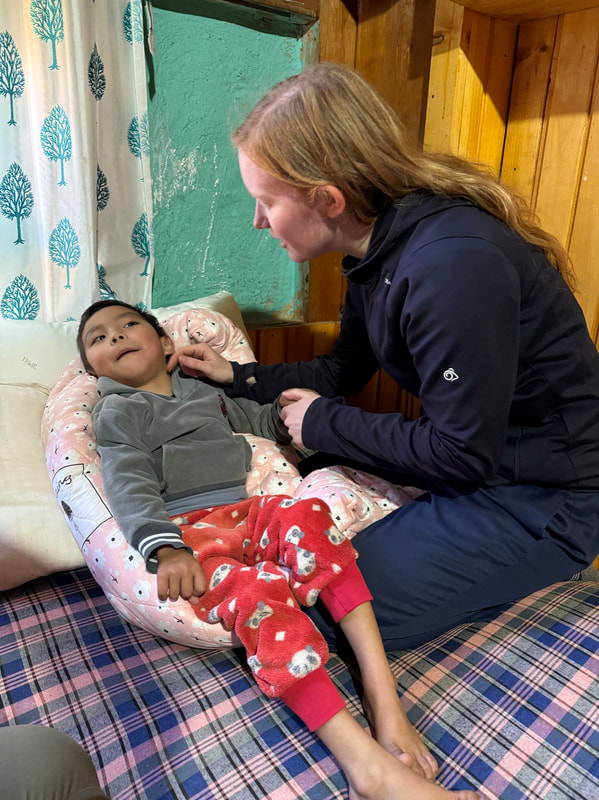
One moment, in particular, stood out. A young boy with cerebral palsy spends most of his day lying flat on his back on a mat. Because the family had never been shown alternatives, this position had become his default. Over time, it had led to pronounced extensor tone: his entire movement pattern was dominated by extension. Whenever he tried to turn onto his side, he extended his head, trunk, and limbs, making the movement impossible. Turning, of course, requires flexion.

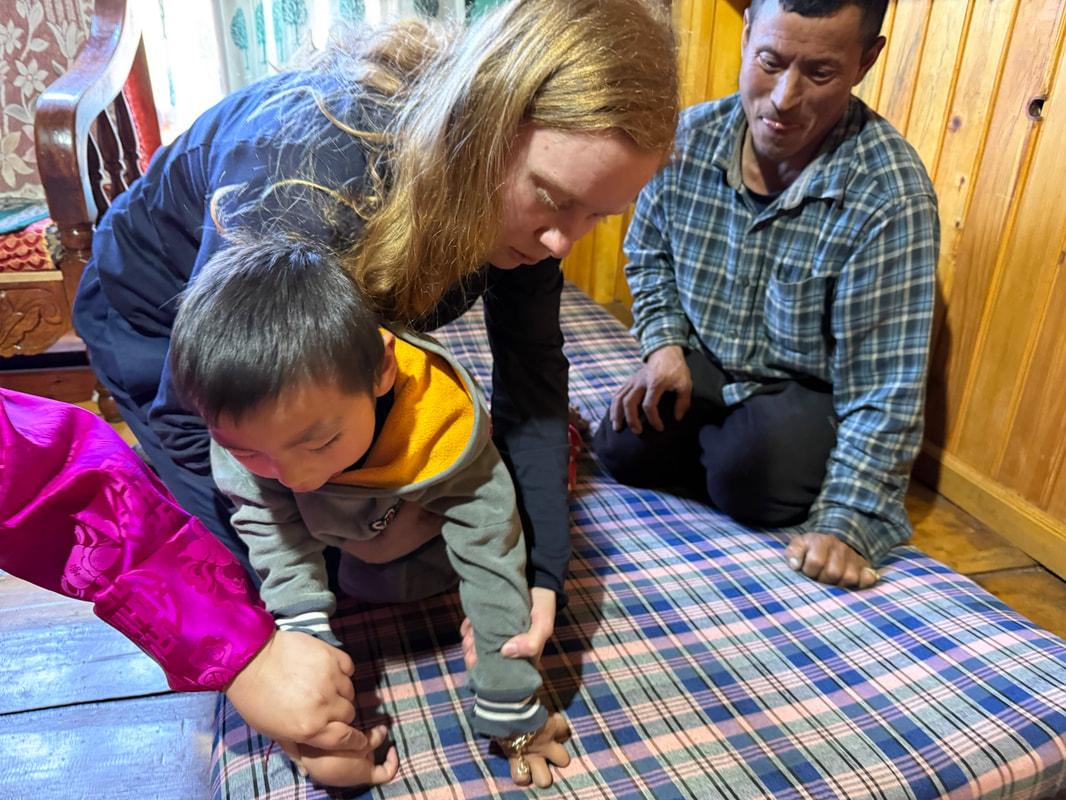
To help the father understand this, I asked him to try the same movement himself—extending his head backward and attempting to roll. He looked at me and said, quite simply, “I can’t do it.” That moment made the problem immediately tangible. I then showed him how to support his son into flexion to enable a more active turn and demonstrated alternative positioning while lying on his back. We rolled a blanket into a nest-like support around the boy’s body and positioned him at about a 40-degree angle using cushions. In this position, he became noticeably more active: his knees flexed, he pushed his heels into the floor, and his feet frequently moved from persistent plantar flexion into a more neutral position. When we explored the prone position, we were all astonished. With minimal support to unload his upper body, he began to lift his hips and crawl with his legs. He was clearly delighted—smiling broadly, eager to continue, and reluctant to stop even when both his father and I grew tired from supporting him. When placed on his side to rest, he immediately tried to turn back onto his stomach to keep going. It was as if discovering this new way of experiencing his body—and a means of moving forward, even with assistance—was profoundly meaningful to him.

His father watched in fascination as I showed him how to support these movements himself. The grandparents, who had been observing quietly, were visibly moved and close to tears. Their gratitude was palpable.

The family has now agreed to come to Thimphu for a month during the winter break specifically to receive therapy and learn how to better support their son. Since the other children will not be present during this period, I will be able to work with him several times a week and make the most of this limited time before he returns home. I am very much looking forward to it.
Picture
0 Comments


Leave a Reply.

Copyright by schochworks gmbh. All rights reserved.