Swissphysiobhutan
  • Home
  • How to support
  • Partners
  • Weekly Blog
  • Contact & About
  • Home
  • How to support
  • Partners
  • Weekly Blog
  • Contact & About

Bhutan Physio

and culture blogs

Equipping children with CP with communication devices

12/6/2026

0 Comments

 
Picture
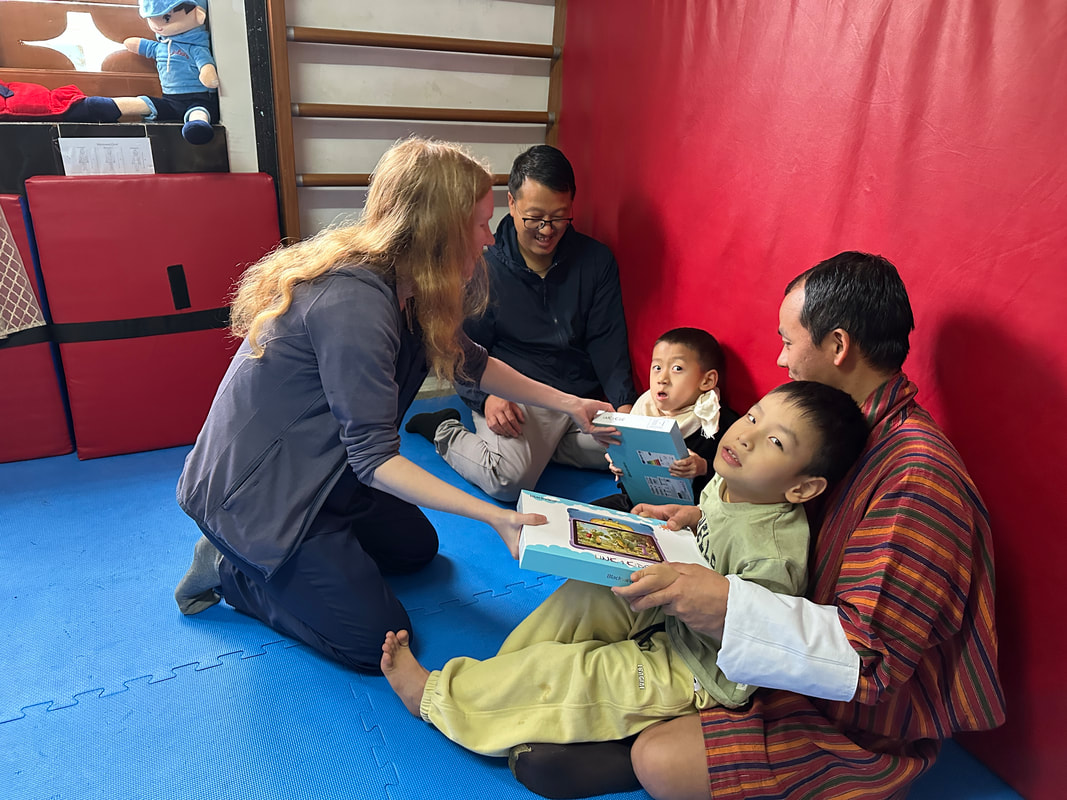
With part of the donation money, I was able to provide four children with a tablet and an AAC app — an Augmentative and Alternative Communication app. These tablets, together with the app, will now belong to each child and become their personal communication tool.

For quite a while, I had been trying out different AAC apps with children with cerebral palsy (CP) and other children to find out for whom this kind of support would really make a difference. These four children with CP always enjoyed using my iPad with the AAC app, because it allowed them to communicate so much more. Even during therapy, they often requested by themselves to use the app. When I asked them what they wanted to do, they usually pointed to the table where we sat together to practise with the communication app.
These children understand a lot and probably have whole sentences in their minds, but they are only able to verbalise a few slurred words. The person listening then often has to guess what exactly the child means and can only offer a few suggestions, which the child can then confirm by nodding. It is easy to understand how frustrating this must be when no one understands what they want to say. That is why it means so much to them when, through the AAC app, they are suddenly understood and can express themselves in three-word sentences. I was also amazed by how quickly they learned where to find the different vocabulary, as the pictograms are often hidden under three layers. For example, the child first has to click on “things”, then “toys”, and only then can they find a specific toy such as “blocks”, which they want to work with in therapy. Usually, I only had to show them once where to find something, and then they remembered it and could find it again, even a week later.
One time, one of the children communicated with the app: “Leanna likes green.” I looked at him in surprise and said, “You remember from last therapy, a week ago, that I told you my favourite colour is green?” He was so proud that I understood what he wanted to say, and that I was amazed he had remembered it. He also communicates during the session: “I want water” and “give me.” Then he drinks the whole glass in one go, and I can see that he was really thirsty. Without the app, I most probably would not have found out what he wanted. I usually know that he wants something, but it is often difficult for me to understand exactly what it is, or what he is trying to say verbally. I am sure that for him, it will make a huge difference when he starts school next year if he is able to communicate with the AAC app. There is even one boy who can hardly use his arms voluntarily, but has much better coordination with his legs. So he uses the AAC app with his big toe — and he is very skilful with it.
Today, we set up the individual tablets for these children. Over the next week, the parents will set up the Avaz app — the AAC app the children are using — according to the specific needs and vocabulary of each child. This will take some work for the parents: sorting out unnecessary vocabulary and adding specific words, such as the child’s toys, photos of family members, and other important things from their daily life. I am convinced that these AAC devices will help the children a lot. So thank you so much to all the donors who made it possible to provide these children with their own tablets and communication tools!
0 Comments


Leave a Reply.

Copyright by schochworks gmbh. All rights reserved.